Category: Course Review

  • Booming Bookkeeping Business Scam Exposed — My Results

    Booming Bookkeeping Business Scam Exposed — My Results

    When I encountered Booming Bookkeeping Business (BBB), suspicion enveloped me. The ads were too shiny, too easy—guaranteeing to “build a bookkeeping business from scratch” and “replace your income” regardless of prior experience. Too many online training platforms had promised the world but delivered little, especially in the financial and online-work arenas. However, after registering, diving headfirst into lessons, participating in communities, and sharing experiences with other real students, I can say with certainty: this course works for the right person—provided that person is willing to do the due diligence.

    This review also chronicles my own experience in intricate fashion, combining my own observations of the class with published observations of others, as well as a description of all that you can realistically expect should you decide to matriculate.


    My Starting Point

    Before entering BBB, my experience with bookkeeping was limited at best; I had ventured into QuickBooks Online to handle side businesses and my own freelance accounting. However, I was not professionally certified in bookkeeping and didn’t have much confidence when it was time to offer bookkeeping services to real clients. The nuance of figuring fees, creating proposals, and finding small businesses who would take the time to buy such services eluded me.

    When considering joining the course, my mind was set on generating a reliable source of income that could be managed from a distance. The potential of running a virtual bookkeeping practice was tempting: it was flexible hours, low overhead, and consistent demand. However, I was in need of a crystal-clear roadmap.


    The Structure and First Impressions

    BBB unfolds in stages, beginning with mindset and foundations before progressing to marketing, client onboarding, and monthly workflow. The dashboard presents a clear and intuitive layout. Each section features videos, downloadable templates, and assignments designed to encourage you to take small steps rather than simply watching an endless stream of lectures.

    I enjoyed the introductory lessons that put an emphasis on psychology of prices as well as business design. Perhaps that is one of the most overlooked parts of freelancing. Newbies mostly undervalue their service, viewing bookkeeping as a mere commodity. However, BBB instructs you on marketing and promoting your service as a real business owner, not as a gig worker.

    One of the best things from the beginning was the mindset re-setting. Before one gets into the details, the course asks you to define your niche, set a clear minimum monthly rate, and put yourselves out as a genuine professional. It sounds a bit fluffy, but it lays the ground for confidence when you do deal with clients in the end.


    The QuickBooks Training

    Let’s be frank: if you want in-depth accounting training or technical proficiency necessary for CPA-level knowledge, you’ll find that this course isn’t a substitute. The QuickBooks tutorials ground zero in the basics—creating accounts, reconciling transactions, assigning expenses, cleaning up financial records, and generating month-end reports.

    The curriculum is more of the “operational” rather than the “academic” kind. It instructs you exactly what you need to do to handle small-business clients, not condense for an accounting exam. The coursework shows a smooth transition from onboarding to financial statements. I learned that with a few hours of hands-on practice in QuickBooks Online’s demonstration company, I could implement it all almost immediately.

    Just keep in mind that some of the screen shots could appear slightly old-fashioned — you may notice a lag between the interface shown and the current QuickBooks interface. It is not a dealbreaker, but you need to be adaptable. I stopped often, checked against the new menus, and proceeded.


    The Sales and Marketing System

    This is where BBB gets its name. Debits, credits, and reporting is all most bookkeeping courses ever worry about – but getting paying clients. Bill Von Fumetti’s greatest strength is in teaching you to make skill into income.

    The marketing side walks you through making your offer, creating lead generation, and starting conversations that aren’t desperate or stalker-esque. There are templates for outreach emails, follow-up communications, and discovery calls. The tone is professional and friendly — not pushy. You’re encouraged to make it all sound like you by customizing it.

    BBB’s system is consistency, not perfection. The rule is that if you make contacts with 10–20 prospects a day and it occurs week in and week out, you’ll start receiving calls, make offers, and finally bring in customers. Even they provide you with a simple spreadsheet to log your activities for the day so you can see activity instead of waiting for luck.

    Within my first month, I was able to schedule three discovery calls using these strategies. One of these calls became a paying client, but that one client paid for my course in less than six weeks. Other members of the community reported similar results — some were quickly able to land multiple clients, but some did not land clients for much longer. The common thread became obvious: only the members who went on the calls and followed the system saw rewards.


    The Community and Coaching

    BBB’s private community is among its best features. It is a Facebook group supplemented by regular weekly Zoom calls, providing all members with a venue for inquiry about anything from untangling messy books to handling edge cases in fees. By joining the group, you encounter members who range from the absolute newbie, through side hustlers, to seasoned bookkeepers growing their businesses.

    It was the tone that stood out most. The moderators and veteran students are genuinely helpful. There is no condescension or “figure it out yourself.” Members post real screenshots, pricing issues, red flag client signs, and victory celebrations.

    The weekly calls take place as interactive workshops. Bill or one of the coaches goes through recent case studies, answers questions, and outlines new strategies. I’ve endured lectures that promised “live support” as a recorded sales webinar repeat — that isn’t these. The coaches actively interact, and they remember student names. It is more of a small classroom environment than a huge online funnel.

    Even after a year of being a member, many students said they stick around because it makes them feel responsible. That sense of community—knowing that there’s someone else prospecting, running through scripts, or bringing on new clients—keeps you on track.


    Realistic Workload and Results

    Let’s talk about the elephant in the room: is it an overnight success? No. Anything genuine isn’t.

    It gives you a system, but you must still take the initiative for implementation. The outreach system will give you results if you avail yourself of it. The accounting templates make you more efficient when you use them in practice. BBB is not a “done for you” kind of franchise, but it is a system that rewards diligent effort.

    The prior two weeks were for completing the basic lessons and for my Google Workspace, Calendly, and proposal templates setup. During the final two weeks, all of my time was for outreach activities. I reached out to around 150 small-business owners, including neighborhood service providers, online shop vendors, and coaches. This outreach secured around 10 responses, three calls, and, as a culmination, one client.

    By the third month, I had secured another client and my confidence blossomed. While I wasn’t yet ready to leave my old job, I was making enough to clearly envision the path ahead. The feedback loop of “do the work, receive calls, refine the script, and repeat” created a powerful momentum.

    Many BBB students share this arc. Some go full-time within six months, others treat it as a part-time side business. The difference almost always comes down to how consistently they do the outreach and how well they manage follow-ups.


    Pricing and Packaging Takeaways

    If there’s one that fundamentally changed the mindset, it would be the pricing mechanism used in BBB. The course reinforces that you’re not selling by the hour, but you’re selling outcomes. You’re not billing by the hour, but you’re billing by a monthly retainer based on deliverables — reconciliations, reports, meetings — not by minutes.

    You’re also taught to separate cleanup work from ongoing services. For example, if a new client’s books are messy, you price that as a one-time cleanup project rather than letting it eat into your regular retainer. It’s such a simple concept, but it’s the difference between profitable and painful client relationships.

    Before BBB, I would’ve charged $200/month for the simplified month-end service that became 10-hour loads. Today, I comfortably charge $500–$800 for simplified month-end service and $1,000–$2,000 for clean-up depending on complexity. And because the value and process is transparent, clients willingly pay it.


    The Keyboard Rich Challenge Week Experience

    Prior to joining the complete program, I signed up for BBB’s “Keyboard Rich Challenge” – a 5-day short course that teaches the basics of virtual bookkeeping. I was expecting fluff, but it did not. It had concrete steps for each day, practical examples, and live-coaching zest. It is more inspiring than technical, but it lays the ground for the complete curriculum.

    Some individuals on the internet voice their grievances, claiming it’s pre-recorded—which, for the most part, it indeed is—but the substance of the content remains strong. The challenge presented can assist you in determining whether bookkeeping resonates with your personality and aspirations. If, after day five, you feel invigorated, you’re likely to relish the entire course.


    Widespread Criticisms and How I Feel

    No program is perfect, and BBB is no exception. Its shortcomings most commonly criticized that I’ve seen (and occasionally experienced them are:

    • Some QuickBooks tutorials include old images.
      Indeed, some screen recordings rely on older versions. The fundamental logic remains relevant, yet you should anticipate making minor adjustments.
    • Outreach emphasis can also come off as being salesy.
      If you’re shy, you might cringe at the idea of messaging hundreds of strangers. The scripts make it easy, though, and when you see that you’re giving real help, it no longer becomes about “sales.
    • Not for advanced accountants.
      If you happen to already be a seasoned CPA or enrolled agent, BBB would come on too weak. It is written for individuals who aim to create or re-establish a small bookkeeping practice, not to learn about forensic accounting.
    • Effort required.
      Some students want passive income. This isn’t that. You need to arrive, learn, message prospects, overcome objections, and service clients. It is easy, but not easy.
    • Marketing language feels bold.
      Indeed, the sales page makes large income statements. In reality, the results range greatly. Some of the students earn $5K/month, some more, some less. Those results are based almost completely on execution.

    Personally, none of these issues took away from the experience. The course did better than expected in design while refraining from overmarketing of shortcuts — rare in this field.

    What I Learned

    Six months in, here is what I had with me:

    • Clarity. Finally, I understood what a true bookkeeping practice is: contracts, retainers, deliverables, and limits with the client.
    • Confidence. Selling no longer felt like begging. I knew how to explain value clearly.
    • Community. The accountability partners and friends that I had in class became my main community.
    • Income. Two regular monthly clients expanded to four, all online. It wasn’t life-changing money yet, but it was consistent.
    • Systems acted as templates for onboarding, engagement letters, and monthly reviews, saving hours each week.

    BBB did not only train me in QuickBooks, it educated me on thinking as a business owner.

    Tips If You Join

    • Take it seriously from day one.
      Don’t binge-watch lessons and not put them into practice. Real development is when you accept imperfect action.
    • Leverage the community.
      Ask questions, answer calls, and revel in victories. The more you participate, the more you learn.
    • Measure outreach statistics.
      It’s a numbers game. Keep track of messages, responses, and calls you make. Those statistics show you where you must make some fixes.
    • Don’t Overanalyze Niche Selection.
      Something basic — service companies, brick-and-mortar units, online coaches — and begin from there. Always change gear later.
    • Invest in supplemental QBO practice.
      Immerse yourself in the QuickBooks test company. Familiarity nurtures confidence.

    Who It’s For

    Appropriate for:

    • Career transitioners seeking a home-based enterprise.
    • Homebound parents or telecommute-job seekers.
    • Bookkeepers who understand the basics but can’t pull in clients.
    • Caretful, dependable individuals who enjoy supporting small businesses.

    Non ideal for:

    • Advanced accountants seeking opportunities for ongoing education.
    • Anyone unwilling to prospect or talk to clients.
    • Those who seek immediate results with no consistent work.

    Cost and Value


    Cost

    It’s an investment, it is. But compared to beginning most businesses, it is pretty low-risk. It guides you through the entire process of operation — legal establishment, branding, pricing, marketing, onboarding, and delivery. I would’ve wasted months figuring all that out by guesswork on YouTube for nothing.

    Should you implement even a portion of the outreach system, you might recoup your investment with just one or two clients. From that point onward, all that follows is profit and expansion.

    My Honest Verdict

    Is the Booming Bookkeeping Business really worth it?

    For me, yes — but for reasons beyond financial.

    It provided clarity, a support community, and the guts to go from dabbling to truly operating a business. The system works if you do. It is not a shortcut or a “push button” course; it is a detailed roadmap from zero to booked.

    You’ll still need to experience the uncomfortable moments—the texting of strangers, quoting of prices, and touching of client books that resemble crime scenes. But if you’re all about that, then BBB provides you with the training, scripts, and community you need to turn your desires into a reality.

    I’ve enrolled in other business schools where the mentorship ends after you’ve paid. BBB is not that. It is a live community, and the coaching staff cares about you. Even after months, I still jump into calls when I run into dead ends.

    Conclusion Remarks

    If you’re in here considering joining, my answer is straightforward: Do not recruit for the promise of easy money. Sign up for the promise of stability. If you’ve felt stuck in the process of research — watching tutorials, waiting to make connections with clients, debating how to charge for your service — BBB guides you through it. It turns “someday” into a plan of action.

    Would I suggest it to everyone? No. If you hate numbers or you won’t sell, you’ll fail. If you’re disciplined, well-systematized, and want to learn, it well may become one of the best investments you make in your business.

    Among all the muddled “make money online” products, Booming Bookkeeping Business is differentiated by being practical, clear, and real. It is not going to do it all for you — but it


  • Writing Revolt by Jorden Roper (Makelle): The Definitive, No-Fluff Review (2025)

    Writing Revolt by Jorden Roper (Makelle): The Definitive, No-Fluff Review (2025)

    If you’re trying to build a freelance writing business from scratch, Writing Revolt sits in that rare middle ground between motivational fluff and enterprise-level complexity. It’s a tight, execution-first ecosystem built around two flagship programs—Killer Cold Emailing (KCE) and *F Yeah Freelance Blogging (FYFB)**, plus a steady stream of free training. Below, I’ll walk you through exactly what you get, how it’s taught, who it’s really for, and the pitfalls to avoid. I’ll also give you a practical 30-day plan, a downloadable outreach tracker, and a side-by-side of reported student outcomes so you can judge the program on its real leverage points.


    What you actually learn (and why it matters)

    Killer Cold Emailing (KCE)

    Most new writers stall not because they can’t write, but because they can’t consistently get in front of buyers. KCE tackles that bottleneck head-on. Rather than sending you into a maze of “maybe someday” marketing, it gives you a linear path:

    1. Pick a niche and claim a simple offer. The point isn’t to find the “perfect” niche. It’s to choose a lane fast so your emails don’t read like generic spam. You’ll position yourself around outcomes (traffic, demo requests, authority content) rather than “I like writing.”
    2. Ship a one-page sales site. A lean homepage (headline, outcomes, two samples, one CTA) outperforms a sprawling portfolio because prospects can understand you in 15 seconds. The course shows what to include and what to ignore. It’s deliberately opinionated.
    3. Prospect like a pro. You learn to find decision-makers (not info@ inboxes), pull clean email addresses, and track everything in a spreadsheet so follow-ups happen automatically. This is where most “free advice” online is vague; KCE is very literal about who to contact and how to store the data.
    4. Write emails people actually answer. Short, specific, and personalized: one-to-two lines tied to a real trigger (e.g., a stale blog, a funding round, a hiring push). Templates are included, but the focus is on why those lines work, so you aren’t stuck if a template stops performing.
    5. Handle replies like a closer. You’ll move from “Sure, send something over” to a small paid pilot by anchoring scope, timeline, and value. The sales guidance is simple on purpose—which is exactly what beginners need.

    F* Yeah Freelance Blogging (FYFB)

    Once the pipeline opens, FYFB helps your delivery justify better rates. It’s less about “word count” and more about structure, briefs, and outcomes:

    • Structure: Hooks that lock in attention, subheads that move readers, CTAs that make sense for the business, and closes that don’t fizzle.
    • SEO fundamentals: Intent, simple on-page work, and briefs that help clients approve faster.
    • Packaging and pricing: You’ll see how to lift a post from a $100 “blog” to a $300–$400 content asset by tightening angle, evidence, and CTA alignment. The difference is process, not poetry.

    Together, the two programs form a practical loop: KCE gets you in the room; FYFB helps you stay there and raise your rates.


    How the material is delivered

    Lessons are short and unapologetically direct. You get videos, checklists, and fill-in-the-blank assets (email scripts, site copy scaffolds, trackers). The philosophy is “learn only what you need right now, then ship.” That’s why the program resonates with career-switchers who don’t want to spend months studying before taking action.


    Community, support, and what’s not included

    There’s a private student community (most active on Facebook) that’s good for quick feedback on homepages, samples, and pitches. You’ll get accountability if you ask for it. What you won’t get is a proprietary job board. That’s intentional: the program is built on proactive outreach, not waiting in application lines. If you’re allergic to pitching, you’ll struggle here.


    Pricing, payments, and policy stance

    Writing Revolt runs on offer windows and occasional promotions. Payment plans are typically available, but buyers should go in knowing the program’s refund stance is strict. That’s neither “good” nor “bad,” but it does mean you should only purchase when you’re prepared to execute immediately.


    Results: what students actually report

    Across public write-ups and community anecdotes, the pattern is consistent: early revenue tends to track outreach volume + follow-ups + rapid iteration. Newer writers report first wins within weeks when they send daily and keep improving their pitch and samples. Others stall for months if they keep “getting ready to get ready.” Results are self-reported (not guaranteed), but the through-line is clear: consistent action is the multiplier.

    You can scan the comparison table in the Student Outcomes section below and download the CSV to reference while you plan your first month.


    Strengths and trade-offs

    Writing Revolt’s greatest strength is clarity. Instead of drowning you in theory, it gives you the smallest set of actions that move the needle, pick a lane, publish a page, build a list, send, follow up, iterate. That bias toward execution is exactly what most beginners need. The trade-off is that you won’t find deep dives on agency systems, subcontracting, operations at scale, or building inbound funnels beyond the basics. If your dream is “clients come to me while I sleep,” you’ll need to pair this with a longer-term inbound plan later.

    The other trade-off is philosophical: there’s no “safe” place to hide. Because the program is built on outreach, you’ll either send the emails or you won’t. Students who thrive here want a clear plan and the push to act; students who want guarantees or refundable trials often feel uncomfortable with the responsibility that comes with that freedom.


    Who this is really for

    • Best fit: career-switchers and early-stage writers who are ready to be uncomfortable for a few weeks while they build momentum. If you can commit 60–90 minutes a day to prospecting, personalization, and follow-ups, and you’re willing to ship a one-page site and two samples in week one, you’ll extract the most value.
    • Probably not: people who want inbound-only leads, guaranteed placements, or a program they can “try” without committing.

    Your first 30 days (with a working tracker)

    This plan reflects how students tend to move from zero to first revenue fastest. It’s intentionally simple so you’ll do it.

    Week 1 — Build the sales engine, not a portfolio museum

    Publish a single-page site with a clear promise, two tightly written samples in your niche, and one obvious CTA. Post the page in the student group for critique. Implement changes within 48 hours. The goal isn’t perfection; it’s speed to clarity.

    Week 2 — Prospect and send, every weekday

    Build a list of 120 decision-makers across 3–4 aligned industries. Send 60 targeted emails this week with two scheduled follow-ups (Day 3 and Day 7). Keep personalization to one or two lines that tie to a real trigger (a stale blog, a new product, a hiring spree). Track everything.

    Week 3 — Tighten and close

    By now you should have replies. Book three discovery calls and close one small paid pilot. Update your pitch to reflect the objections you heard. Add one more sample—this time aligned to a real client conversation.

    Week 4 — Improve delivery and raise your anchor

    Use FYFB’s structure to produce your paid piece, then update your site with tighter messaging and a higher anchor rate. Keep sending 10–20 emails per weekday while your small wins turn into predictable work.


    Outreach Log (table + downloads)

    Use this table to track volume, personalization, and follow-ups. If it isn’t logged, it didn’t happen.

    FieldDescriptionExample
    Date_Sent (YYYY-MM-DD)Date you sent the first email2025-08-20
    CompanyProspect company nameAcme SaaS
    WebsiteProspect website URLhttps://www.acme.com
    Decision_Maker_NameFirst & last nameJordan Quinn
    Role / TitleTheir job titleHead of Marketing
    EmailContact emailjordan.quinn@acme.com
    Prospect_SourceWhere you found themLinkedIn, Google SERP
    TriggerWhy nowBlog stale; Hiring content
    Niche_ServiceYour offerSaaS blogging (2 posts/mo)
    Pitch_Variant (A/B/C)Which version you usedA
    Personalization_SnippetOne-to-two lines tied to a trigger“Loved your case study on X—noticed the blog slowed; idea inside.”
    Followup_1_DateFirst follow-up2025-08-23
    Followup_2_DateSecond follow-up2025-08-27
    OutcomeStatusCall booked / Won / Lost
    Deal_TypeIf won, whatBlog post / Case study
    Deal_Value_USDDollar value350
    Next_StepYour next actionSend 2-post proposal
    NotesAnything notableMention competitor benchmarks

    How to use it: log 10–20 new prospects daily, batch personalize, and schedule both follow-ups at the moment you send the first email. Review the sheet every morning and clear follow-ups before adding new prospects. This is how you keep momentum when motivation dips.


    Student outcomes (self-reported)

    These snapshots aren’t guarantees; they illustrate how consistent outreach tends to convert into early revenue. Notice the pattern: those who send daily and iterate quickly usually report first wins fastest.

    StudentTimeframeReported OutcomePrimary TacticNotes
    Nabeel3 weeks$2,800Targeted cold emails + follow-upsEarly-stage; daily cadence.
    Krystal2 weeks$3,600Cold pitchingQuick start from consistency.
    Marley (FYFB)Initial app.$2,500FYFB blog frameworkPackaging increased value.
    CaitlinPre-outreach$750Warm method taught in KCELanded client before cold emails.
    Meaghan~2 months$4,000/moCold outreach + LinkedInProgress after overcoming avoidance.
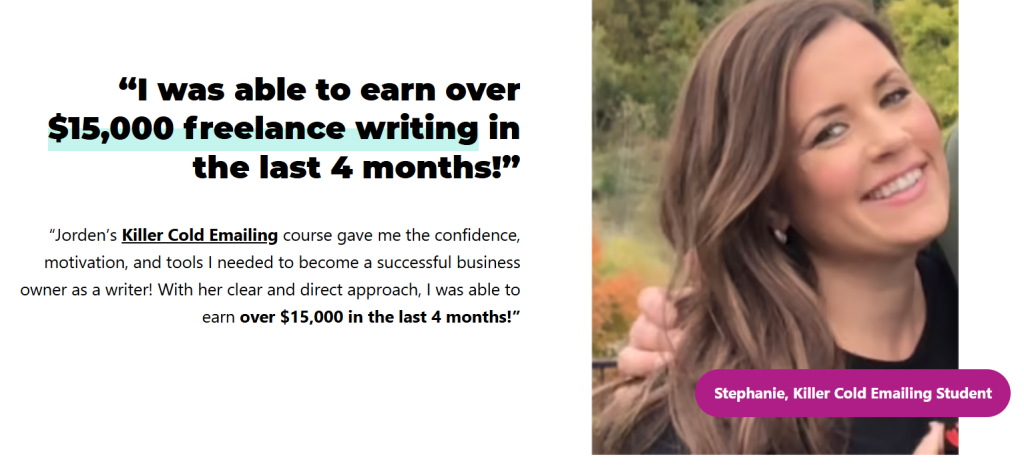
    Stephanie4 months$15,000 totalConsistent outreachBeginner; compounded simple actions.

    Use the table to calibrate expectations. If you can commit to a daily sending habit and iterate your angle weekly, the model can pay for itself quickly. If you prefer to wait for inbound leads or dislike outreach, you’ll feel friction.


    Practical tips to maximize ROI

    • Protect an outreach block of 60–90 minutes every weekday. Treat it like a client meeting.
    • Personalize with discipline. One or two lines tied to a real trigger beat paragraphs of flattery.
    • Ship one new sample per week in the same niche you’re pitching. Your samples are your silent closers.
    • Review objections weekly and update your subject lines, openers, and CTAs accordingly.
    • Use the community deliberately. Post drafts, ask for blunt feedback, implement within 48 hours.

    Final verdict

    Writing Revolt is legit and built for doers. If you’re ready to send pitches, follow up, and improve fast, the KCE → FYFB combo provides a clear path from zero to first clients and into the $200–$400-per-post range. It isn’t a fit if you want guaranteed placements, inbound-only work, or a risk-free trial. But for decisive beginners and career-switchers who will run the 30-day plan and track their numbers, it’s one of the most direct routes to a functioning freelance writing business.

  • My Brutally Honest 90 Day VA Review: The Good, The Bad, and The Gigs

    My Brutally Honest 90 Day VA Review: The Good, The Bad, and The Gigs

    It was another Sunday night, and the familiar knot of dread was tightening in my stomach. I was staring at my calendar, at another week in a job that paid the bills but drained my soul. I kept thinking, “There has to be another way.”

    That thought led me down the rabbit hole of remote work, where I stumbled upon the world of Virtual Assistants. And just as quickly, I stumbled upon Esther Inman’s 90 Day VA program.

    If you’re here, you’ve probably seen what I saw: dozens of reviews. Some call it a life-changing opportunity. Others whisper about it being just another “90 day challenge scam.”

    This review is different. I’m not just summarizing the course. I’m taking you inside my own journey, from feeling stuck and skeptical to landing my first paying client. I’ll give you a brutally honest look at the modules, the much-hyped job board, and the critical truths other reviews leave out.

    This is the deep-dive I wish I had when I was on the fence.

    What is 90 Day VA, Really?

    On the surface, 90 Day VA is a step-by-step online course designed to turn absolute beginners into professional Virtual Assistants in about three months. It was created by Esther Inman, a former teacher who successfully built her own VA business and packaged her system for others.

    Unlike generic freelance courses that teach a bit of everything, 90 Day VA is laser-focused on the practical, in-demand skills clients are hiring for right now:

    • Content Repurposing: Turning a single blog post or video into a dozen social media updates.
    • Social Media Management: Scheduling content and engaging with audiences on platforms like Instagram and LinkedIn.
    • Email & Newsletter Support: Formatting and scheduling emails for business owners.
    • Simple Podcast & Video Editing: Basic editing to help creators repurpose their audio and video.
    • The “Bread and Butter”: Admin tasks, online research, and managing calendars.

    It’s designed as a complete roadmap, from learning the skills to building a portfolio (even with zero experience), finding clients, and managing your business.

    My Journey Inside the 90 Day VA Modules

    Listing the 11 modules doesn’t do the experience justice. Here’s how it actually felt going through the program.

    Part 1: The Foundation (Mindset & Skills)

    The first few modules are about more than just skills; they’re about shifting your mindset. For me, the Mindset & Foundations module was the permission slip I needed to start thinking of myself as a business owner, not just someone looking for a job.

    From there, I dove into the core skills. I was most nervous about the tech, but the lessons were surprisingly simple. The Content Repurposing module was a game-changer. I followed a lesson step-by-step and created my very first portfolio piece—a set of Instagram graphics based on a blog post. It wasn’t perfect, but it was real. It was tangible proof that I could do the work.

    Part 2: The Business End (Finding and Pitching Clients)

    This is where the rubber meets the road, and honestly, it’s the most terrifying part. The modules on Finding Clients and Pitching Clients were my lifeline. The course provides scripts and templates, but more importantly, it teaches you where to look for clients beyond crowded marketplaces like Upwork. It encourages proactive outreach and networking in a way that felt authentic, not spammy. I sent my first five pitches using a template from the course, and while four were rejections, one led to a conversation—and that small win was everything.

    Part 3: The Pro Systems (Onboarding & Scaling)

    The final modules cover the things you don’t know you need until you need them: contracts, invoicing, and client onboarding systems. The templates here saved me hours of guesswork and made me look professional from day one.

    The Two Things That Make 90 Day VA Stand Out

    Any course can teach you skills. But there are two elements that, in my opinion, justify the price tag.

    1. The Exclusive Job Board: This is the program’s killer feature. It’s a private job board where businesses post opportunities exclusively for 90 Day VA students. These are warm leads. The clients already know what 90 Day VA is and trust the quality of the training. I landed my first recurring client from this board, and it wouldn’t have been possible otherwise.
    2. The Community: The private Facebook group is more than just a support forum; it’s a massive network of thousands of fellow VAs. When I got stuck on a client task, I posted a question and had three helpful answers within 20 minutes. It’s a place to celebrate wins, ask “dumb” questions, and get real-world advice from people who are on the same path.

    The Brutally Honest Pros and Cons of 90 Day VA

    No course is perfect, and if a review only tells you the good parts, it’s a sales page, not a review. After going through the program and analyzing feedback from other students, here’s a balanced breakdown of where 90 Day VA shines and where it falls short.

    What I Loved: The Pros

    • A Complete A-to-Z Roadmap for Beginners.
      The single biggest advantage of 90 Day VA is that it eliminates overwhelm. Before joining, I spent weeks trying to piece everything together from blogs and YouTube, and I was getting nowhere. This course provides a structured, step-by-step path. It covers not just the skills (the “what”) but the business-building (the “how”), from setting your prices to creating a resume and onboarding clients. For anyone new to the online world, this clarity is invaluable.
    • Focus on “Money-Making-Now” Skills.
      Some programs try to teach you complex, specialized skills that take months to master before you can earn a dollar. 90 Day VA focuses on the practical, in-demand skills that business owners need right now, like social media management, content repurposing, and email management. This approach is designed to get you client-ready and earning money as quickly as possible.
    • The Exclusive Job Board is a Legitimate Game-Changer.
      This is arguably the program’s most valuable feature. The private Facebook group contains job opportunities posted specifically for students. These aren’t cold leads from massive job boards; they are from clients who know the quality of 90 Day VA training and want to hire from within the community. Landing your first client is the biggest hurdle, and this feature provides a massive advantage.
    • An Active and Genuinely Supportive Community.
      Starting a new online career can be isolating. The 90 Day VA community provides a built-in network for support and accountability. When you’re stuck on a client task or feeling imposter syndrome, having thousands of peers to turn to for advice is a huge confidence booster. The community is frequently praised in reviews for being highly active and helpful.
    • You Build a Real Portfolio as You Go.
      A common problem for new VAs is the “no experience” catch-22. 90 Day VA directly solves this by integrating portfolio-building into the lessons. As you complete the skills modules, you create work samples you can immediately show to potential clients, allowing you to look professional even before you’ve had a paying gig.

    The Honest Criticisms: The Cons

    • The Hustle Is Not Included (Success is NOT Guaranteed).
      This is the most critical point. The course provides the tools, templates, and roadmap, but it cannot do the work for you. Landing clients requires consistent effort, networking, and sending pitches. Students who expect clients to simply fall into their laps will be disappointed. It’s a program for motivated self-starters, and your results will directly reflect the effort you put in.
    • The Skills Training is Broad, Not Deep.
      To get you client-ready quickly, the course covers a wide range of VA skills. However, this means that some modules (like podcast or video editing) are introductory. They are enough to get you hired for basic tasks, but if you want to become a high-paid specialist in a technical field like search engine optimization (SEO) or advanced web design, you will eventually need to invest in more specialized training.
    • The Video Format Can Be Inefficient.
      Some student reviews, and my own experience, noted that some video lessons are quite long. The course content is excellent, but it sometimes lacks quick-reference materials like downloadable summaries, notes, or timestamps. This means that if you need to find a specific piece of information, you may have to re-watch a significant portion of a long video, which can be time-consuming.
    • The Refund Policy is Short and Action-Based.
      90 Day VA offers a refund, but it’s typically within a short window (like 14 days) and requires you to prove that you’ve done the work and engaged with the material. This “action-based” policy is meant to deter people who aren’t serious, but it’s a point of criticism for those who may want more flexibility. You need to be ready to commit and dive in quickly.

    Is 90 Day VA a Scam? The Verdict on Legitimacy

    Let’s tackle the big question: “Is 90 Day VA legit?”

    It is 100% not a scam. You receive a comprehensive curriculum, valuable resources, and access to the community and job board as promised. However, it’s sold as a pathway to results, and like any educational program, the results are entirely dependent on your effort. It’s a “get-what-you-give” scenario.

    Who Should (and Absolutely Shouldn’t) Join?

    This course is a perfect fit for:

    • The Motivated Beginner: You’re ready to change careers or start a side hustle but feel overwhelmed by information overload and need a clear, structured plan.
    • Stay-at-Home Parents: You want a flexible, legitimate way to earn an income from home without sacrificing family time.
    • Aspiring Digital Nomads: You want to build a location-independent career and need a foundation of marketable skills to get started.

    You should probably skip this course if:

    • You’re an Experienced Freelancer: If you already have advanced marketing, design, or admin skills and know how to find clients, this course will be too basic for you.
    • You’re Looking for a “Get Rich Quick” Scheme: This is not passive income. It takes hard work, consistency, and a willingness to put yourself out there.
    • You’re Unwilling to Network or Pitch: If the thought of proactively contacting potential clients makes you shut down, you will struggle with the most critical part of the process.

    Alternatives to Consider

    For the sake of complete honesty, 90 Day VA isn’t the only option. Here are a few others I considered:

    • Virtual Savvy (Abbey Ashley): A very similar program with a strong focus on building your brand and finding your niche. It’s another highly respected option in the VA space.
    • Freelance University: A broader platform that covers all types of freelancing, not just VA work. It’s more of a subscription library of courses.
    • The DIY Route (YouTube, Blogs, Upwork): The cheapest option, but also the slowest. You can piece together the information for free, but you’ll lack the structure, community, and job board access.

    For me, the combination of a clear path and the exclusive job board made 90 Day VA the right choice to get started fast.

    Final Verdict: Is 90 Day VA Worth the Investment?

    If you are serious about leaving your 9-to-5 and building a real remote career from scratch, yes, 90 Day VA is worth it.

    You are paying for clarity, community, and opportunity. You are buying a shortcut that trims months, if not years, off the painful trial-and-error process of starting a freelance business alone. It’s not magic, and it requires hard work. But if you show up and follow the roadmap, it absolutely delivers on its promise to turn you into a professional, client-ready Virtual Assistant. It was the catalyst that took me from dreaming about a different life to actually living it.